12 August, 2026
Inside a Westin-Managed Clubhouse: What Daily Wellness Really Looks Like
Table of Contents
- 1.Wellness Real Estate Stopped Being a Side Feature
- 2.A Day in the Building, Hour by Hour
- 3.What "Managed" Actually Changes
- 4.The Movement Layer: Water, Racquets and Ground
- 5.The Recovery Layer: The Part Most Projects Underbuild
- 6.The Everyday Layer: Work, Family and Guests
- 7.How to Audit Any Clubhouse Before You Buy
- 8.What This Looks Like at Westin Residences
- 9.FAQs
- 10.The Bottom Line
Wellness in a residence is not a spa weekend. It is a Tuesday.
It is whether you swim before work without planning it. Whether a treatment room is free at 8pm. Whether the studio floor is clean at 6am, every single morning.
Brochures show the pool. They rarely show the operating hours, the staffing, or who resets the room after you leave. Those are the parts you live with.
This guide walks through a Westin-managed clubhouse the way a resident would use one. You will see the daily rhythm, the layers behind it, and a checklist to audit any clubhouse before you buy.
Wellness Real Estate Stopped Being a Side Feature
The market has already made this decision. Wellness-led design is now one of the fastest-moving parts of global property.
The wellness real estate market reached $876 billion in 2025, up from $151 billion in 2017. (Source: Global Wellness Institute, 2025 — wellness real estate market)
It is forecast to more than double to $1.8 trillion by 2030. (Source: Global Wellness Institute, 2025 — market forecast)
Growth averaged 23.6% a year from 2019 to 2025. (Source: Global Wellness Institute, 2025 — growth rate)
Asia Pacific is a large part of that shift. The region grew from $88 billion in 2019 to $350 billion in 2025, at 25.8% a year. (Source: Global Wellness Institute, 2025 — Asia Pacific data)
Buyers are paying for it too. GWI puts the price premium on wellness-focused residential property at 10 to 25%. That applies at the middle and upper ends of the market. (Source: Global Wellness Institute, 2025 — Build Well to Live Well)
Is a wellness clubhouse just a bigger gym?
A Day in the Building, Hour by Hour
The best way to judge a clubhouse is to imagine one full weekday inside it.
6.30am. You take the perimeter loop for a run, or the trails through the central greens. The route is inside the estate, so there is no traffic and no waiting at a gate.
7.30am. Lap swimming. The pool is open, clean and staffed, because opening hours are part of the operating standard, not a courtesy.
9am. You take a call from the business centre or a workspace rather than your dining table. The sound suite handles anything that needs recording or quiet.
1pm. Lunch in one of the estate's dining venues. Three multi-cuisine restaurants means you are not eating the same thing on repeat.
6pm. Racquet sports. Tennis, badminton, squash or pickleball, depending on the evening and who you can talk into playing.
8pm. The steam room, or a treatment room booked earlier in the day. Recovery is scheduled, not improvised.
9pm. The children are in the kids zone or the games room. On some nights, the movie theatre takes the whole evening off your hands.
None of that requires leaving the estate. That is the actual product.
Do residents really use amenities on a weekday?
What "Managed" Actually Changes
Two projects can list identical amenities and feel completely different to live in. The difference is who runs them.
In a Westin-managed address, the operator sets the standard. Opening hours, cleaning cycles, staffing levels and response times sit in a written manual, not in local habit.
Staff train against that manual. The brand audits its own sites and issues corrective plans when standards drift.
Compare that with a builder-appointed facility team. Standards are usually set project by project, and they change when the contract changes.
The 24/7 hospitality desk in the clubhouse lobby is the clearest expression of this. It is a single accountable point for anything a resident needs, at any hour.
Guest suites work the same way. Visitors stay on the estate, with service, instead of taking over a bedroom in your residence for a week.
Does a managed clubhouse cost more to run?
The Movement Layer: Water, Racquets and Ground
Movement is the part of wellness people actually keep up, so it deserves real space.
Water comes first. Swimming pools carry the widest age range of any amenity, from children learning to grandparents rehabilitating a knee.
Racquet sports come next. Tennis, badminton, squash and pickleball each pull a different group, and pickleball in particular gets people playing who had stopped.
Then there is ground. Running tracks, trails, ponds and a perimeter walking and cycling loop make daily movement the default rather than a plan.
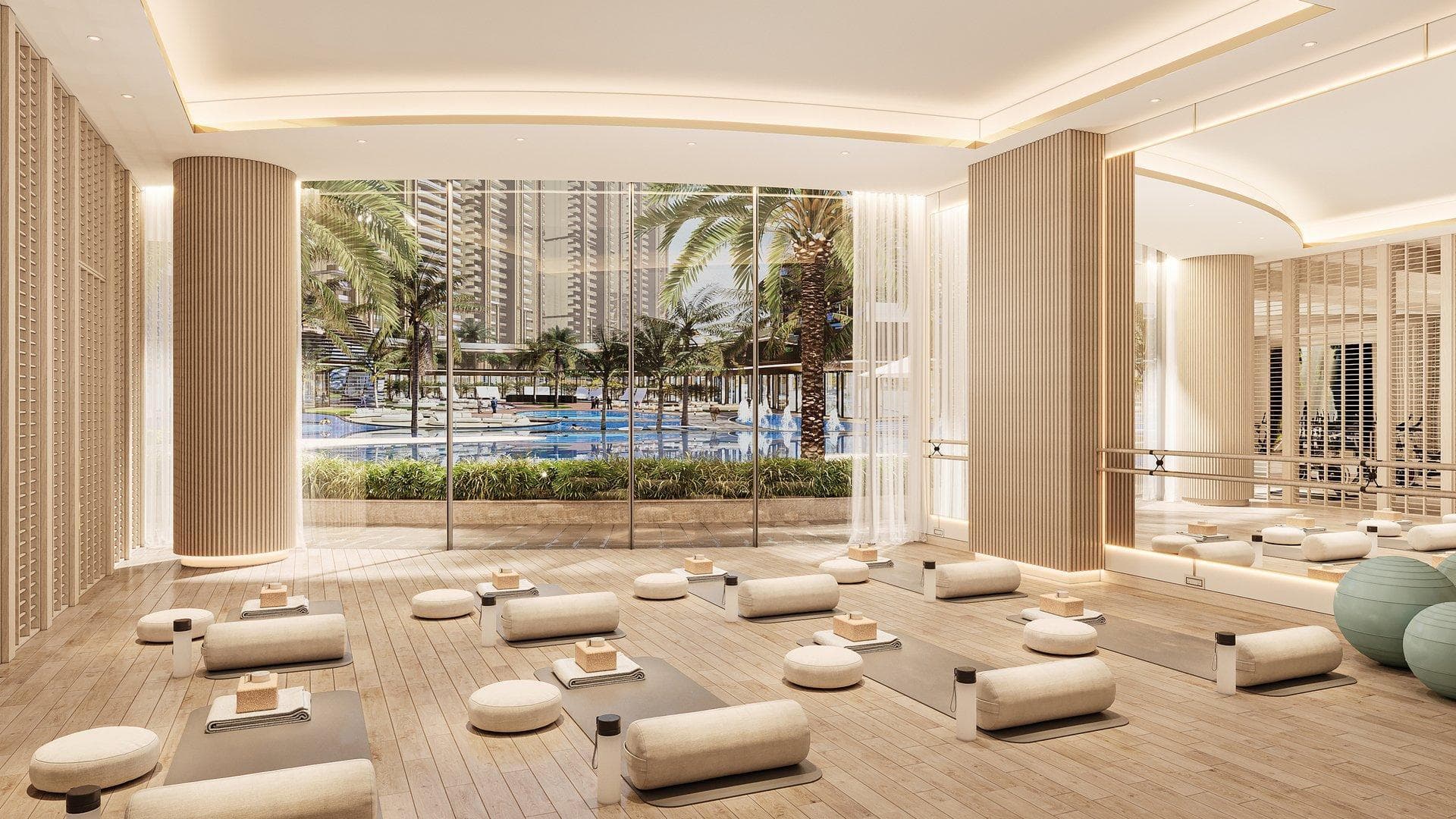
Indoors, the gym floor and the movement and yoga studios cover the structured side. Studios matter because a class creates a schedule, and a schedule creates a habit.
Together these give you options at every energy level. That is what keeps a clubhouse in use in year five, not just in year one.
Quick Facts: Wellness in Residential Property
The wellness real estate market reached $876 billion in 2025. (Source: Global Wellness Institute, 2025 — market size)
It is forecast to reach $1.8 trillion by 2030. (Source: Global Wellness Institute, 2025 — forecast)
Wellness-focused residences carry a 10 to 25% price premium at the middle and upper ends. (Source: Global Wellness Institute, 2025 — price premium)
Asia Pacific grew at 25.8% a year from 2019 to 2025. (Source: Global Wellness Institute, 2025 — regional growth)
The Recovery Layer: The Part Most Projects Underbuild
Movement gets the budget. Recovery gets the storeroom. That is the wrong way round.
Recovery is where a spa, a steam room and specialty treatment rooms earn their space. They turn a hard week into a manageable one.
A salon belongs in this layer too. It sounds cosmetic until you count the hours it saves a household every month.
Quiet is the underrated part. Central greens, ponds and trails give you somewhere to be outside without being on show.
The real test is availability. A treatment room that is booked out three weeks ahead is not a residence amenity, it is a marketing photograph.
Ask how many rooms there are, what the booking window looks like, and who staffs them. Then ask what happens at 9pm on a Sunday.
What should I check about a spa inside a residential project?
The Everyday Layer: Work, Family and Guests
Wellness is not only sport and recovery. Most stress in a household comes from logistics.
Work comes first. A business centre, workspaces and a sound suite change the daily pattern. You stop turning a bedroom into an office and back again.
Family comes next. Kids zones, games rooms and a movie theatre absorb the hours that are otherwise hard to fill inside four walls.
Guests are the third piece. Guest suites let visitors stay close without changing how your household runs that week.
Parking matters more than anyone admits. Underground parking keeps the surface for people and greenery instead of cars.
Buyers in this segment now weigh exactly these things. Analysts covering NCR report that globally exposed buyers are prioritising concierge service, wellness amenities and managed communities. (Source: Construction World, 2026 — NCR buyer preferences)
Are guest suites worth it if I already have a spare bedroom?
How to Audit Any Clubhouse Before You Buy
Take this to the site visit. Ask for written answers, and visit at least twice at different hours.
What are the operating hours for the pool, gym, studios and spa?
How many treatment rooms are there, per number of residences?
Is the clubhouse staff employed by the operator or by a contractor?
What is the booking system, and what is the typical wait?
Which amenities are inside maintenance, and which are billed separately?
What is the projected maintenance charge per sq ft at handover?
Who audits service quality, how often, and do residents see the report?
What is the guest suite policy, including nights and rates?
Then visit at 7am on a weekday and at 8pm on a Sunday. The gap between those two visits tells you more than any brochure.
What is the most common mistake buyers make about amenities?
What This Looks Like at Westin Residences
Set all of that against one live project. Westin Residences sits in Sector 103 Gurugram, on the Dwarka Expressway, developed by Whiteland.
The estate spans 19.23 acres, with towers on 20 to 30-foot stilts, central greens and a perimeter walking and cycling loop.
The clubhouse carries a 24/7 hospitality desk in its lobby, three multi-cuisine restaurants and guest suites for visitors. Movement is covered by a gym, movement and yoga studios, swimming pools, running tracks and trails. Racquet sports run to tennis, badminton, squash and pickleball.
Recovery runs through a spa, salon, steam room and specialty treatment rooms. The everyday layer is handled by a business centre, workspaces, a sound suite, kids zones, games rooms and a movie theatre.
All of it sits under Westin management rather than a builder-appointed team. Residences come in 3 and 4 bedroom formats, with pricing shared on enquiry and possession expected around 2031.
Walk through the full list on the clubhouse and amenities page, then check how it sits on the masterplan. Then visit twice, at the two hours named above.
FAQs
What is a Westin-managed clubhouse?
What amenities does a wellness-led clubhouse usually include?
Do wellness amenities affect property value?
Are clubhouse amenities included in maintenance?
How do I know a clubhouse will still be well run in ten years?
Can guests use the amenities?
The Bottom Line
A clubhouse is not a list of rooms. It is a service that either shows up every day or does not.
The market has already priced this in. Wellness real estate reached $876 billion in 2025, and is forecast to reach $1.8 trillion by 2030. (Source: Global Wellness Institute, 2025 — market data)
Wellness-led residences also carry a measurable premium over standard stock. That premium is why operations, not renders, deserve your attention.
So judge the operations, not the render. Hours, staffing, booking waits, treatment room counts, and who audits the standard.
Then go twice. Once at 7am on a weekday, once at 8pm on a Sunday. Whatever you see on those two visits is what you are buying.
If a managed, wellness-led address on the Dwarka Expressway fits what you want, walk the clubhouse at Westin Residences yourself. Ask the eight questions above while you are there.
About the Publisher:This article is published by Whiteland Corporation, a premium real estate developer with a focus on lifestyle-led residential projects in Gurugram. The insights shared are based on evolving residential trends, buyer behaviour, and long-term market observations.
Recent Blogs
←Back to all blogs
What Makes a Residence Future-Ready?
Read More →
Why Well-Being Is Becoming a Differentiator in Real Estate
Read More →
The Value of Professionally Managed Living
Read More →