10 August, 2026
Dwarka Expressway Is Complete: What It Changed for Gurugram Commutes and Property Values
Table of Contents
- 1.What Was Actually Built, in Plain Terms
- 2.The Airport Run Is the Change People Feel First
- 3.The School Run, the Grocery Run and the Weekend
- 4.What the Road Did to Values
- 5.What Is Still Being Built
- 6.A Short Checklist Before You Commit to the Corridor
- 7.Living On the Corridor: Where Westin Residences Sits
- 8.FAQ
- 9.The Bottom Line
The Dwarka Expressway stopped being a promise in March 2024. The Haryana stretch opened, and a corridor that had been sold on drawings became a road people drive every morning.
The market noticed the price effect. Fewer people have written about the quieter change, which is what a normal weekday now feels like.
This guide covers that. The airport run. The school run. Where you shop, where you get treated, and how long any of it takes.
You will also see what the road did to values. Then what is still under construction, and how to read the numbers without getting misled.
What Was Actually Built, in Plain Terms
Start with the object itself, because the scale explains the effect.
The corridor was built as a fully access-controlled, grade-separated 14-lane expressway. (Source: Business Today, 2024 — project specifications)
Access-controlled matters more than the lane count. There are no shopfronts spilling onto it and no unsignalled turns. Traffic enters and exits at planned points only.
The Haryana section opened first. That was a 19 km stretch built at a cost of about ₹4,100 crore. (Source: Business Today, 2024 — Haryana section)
It also carries India's first 8-lane shallow tunnel near the airport, running about 4 km. (Source: Business Today, 2024 — tunnel detail)
The stated purpose was relief for NH-48, which carries over 3 lakh vehicles a day. (Source: Business Today, 2024 — NH-48 traffic)
Is the whole expressway open now?
The Airport Run Is the Change People Feel First
Ask anyone living on the corridor what changed, and this comes up first.
The road links the Delhi-Gurugram expressway near Shiv Murti with the airport area and Dwarka Sector 21. It then runs to the Gurugram border at Basai, and ends at Kherki Daula on NH-48. (Source: Business Today, 2024 — connectivity points)
The practical effect is that the airport is now a straight line, not a negotiation. You are not crossing NH-48 traffic to get there.
That reshapes small decisions. A 6am flight no longer means leaving at 3am to be safe. A same-day return trip becomes realistic.
For people who fly often, this is the single biggest lifestyle change on the corridor. For families with relatives abroad, it changes how often visitors come and go.
Sector 103 sits directly on this stretch. From there, the airport is about 12 km, per the project's own location material.
Does the expressway help if I do not fly often?
The School Run, the Grocery Run and the Weekend
Big infrastructure gets sold on commute times. Daily life is mostly short trips.
An access-controlled spine changes those too. Local roads stop carrying traffic that was only passing through, which makes short hops calmer.
Retail follows roads. Once a corridor is drivable, food, pharmacy, clinics and schools follow the residents, then expand.
Weekends change shape as well. Central Delhi becomes an easier evening out. So does Aerocity, the Dwarka convention district, and the golf and institutional belt nearby.
There is a trade-off worth naming. A young corridor is still filling in. Some retail and school capacity is still under construction, and delivery timelines move.
Judge the corridor on what is open today, plus what is contracted and funded. Not on masterplan renders.
Are schools and hospitals already operating along the corridor?
What the Road Did to Values
Now the numbers, because they are the reason many buyers looked here at all.
Average prices along the corridor rose about 83% over ten years. That took rates from roughly ₹4,530 per sq ft in 2013 to ₹8,300 per sq ft in 2023. (Source: ANAROCK via Free Press Journal, 2024 — ten-year price growth)
Most of that came after the road became a certainty rather than a plan. Announced infrastructure gets priced in early, and this corridor was no exception.
Supply followed. Around 53,030 units were launched here between 2013 and 2023, and over 80% of them sold. (Source: ANAROCK via Free Press Journal, 2024 — launch and absorption data)
More recent data shows the corridor still moving. ANAROCK put the average quoted rate here at about ₹14,000 per sq ft in Q1 2026. That was up 4% on the previous quarter. (Source: ANAROCK, 2026 — NCR Q1 2026 viewpoints)
Read that figure carefully. It is a corridor average across all stock, standard and branded together. It is not the entry price for any one segment, and branded projects sit well above it.
Quick Facts: Dwarka Expressway at a Glance
Built as a 14-lane, access-controlled, grade-separated corridor. (Source: Business Today, 2024 — specifications)
The 19 km Haryana section was built at a cost of about ₹4,100 crore. (Source: Business Today, 2024 — Haryana section cost)
Corridor prices rose about 83% in ten years, to roughly ₹8,300 per sq ft by 2023. (Source: ANAROCK via Free Press Journal, 2024 — price growth)
Average quoted rate reached about ₹14,000 per sq ft in Q1 2026, up 4% on the quarter. (Source: ANAROCK, 2026 — Q1 2026 data)
A metro spur from Basai to the corridor runs 1.85 km within a wider 28.50 km plan. (Source: The Tribune, 2023 — metro approval)
Rents moved too. ANAROCK's Q1 2026 read puts a 2 BHK rental here in a band of about ₹25,000 to ₹37,000 a month. (Source: ANAROCK, 2026 — rental values)
Has the price growth already happened, or is there more to come?
What Is Still Being Built
The road is open. The network around it is not finished, and that is where the next change comes from.
A cloverleaf interchange links NH-48, the expressway and the Southern Peripheral Road, with a circumference of over 2 km. (Source: Swarajya, 2023 — cloverleaf interchange)
That structure matters for daily driving. It lets people from newer sectors reach NH-48 without going all the way to the Kherki Daula toll plaza. (Source: Swarajya, 2023 — access without the toll detour)
Metro is the bigger one still pending. The approved Gurugram plan runs 28.50 km with 27 stations, at a cost of about ₹5,450 crore. (Source: The Tribune, 2023 — metro plan)
Within it, a 1.85 km spur runs from Basai village to the Dwarka Expressway. (Source: The Tribune, 2023 — spur detail)
Analysts covering the region group this corridor with three other projects. Those are the RRTS, UER-II and the Jewar airport, named together as the set driving demand across Gurugram and Noida. (Source: JLL via Business Today, 2026 — infrastructure drivers)
Should I wait for the metro before buying here?
A Short Checklist Before You Commit to the Corridor
Drive it before you buy it. Then run these seven checks.
Drive to the airport at 6am and again at 6pm, from the actual project gate.
Drive to your likely office, on a Monday, not a Sunday.
Check which entry and exit ramps the project uses, and whether they are open.
Ask which schools and clinics are operating today, with distances.
Ask for the distance to the nearest planned metro station, and its status.
Compare quoted rates within the same segment, not against corridor averages.
Check the HARERA registration for the specific tower you are buying.
Registrations are public. You can verify any Gurugram project directly on the HARERA portal.
What is the single most common mistake buyers make on this corridor?
Living On the Corridor: Where Westin Residences Sits
One live example makes the geography concrete. Westin Residences sits in Sector 103, directly on the Dwarka Expressway, developed by Whiteland.
The estate covers 19.23 acres. Its own location material puts the airport about 12 km away and Qutab Minar about 17 km away.
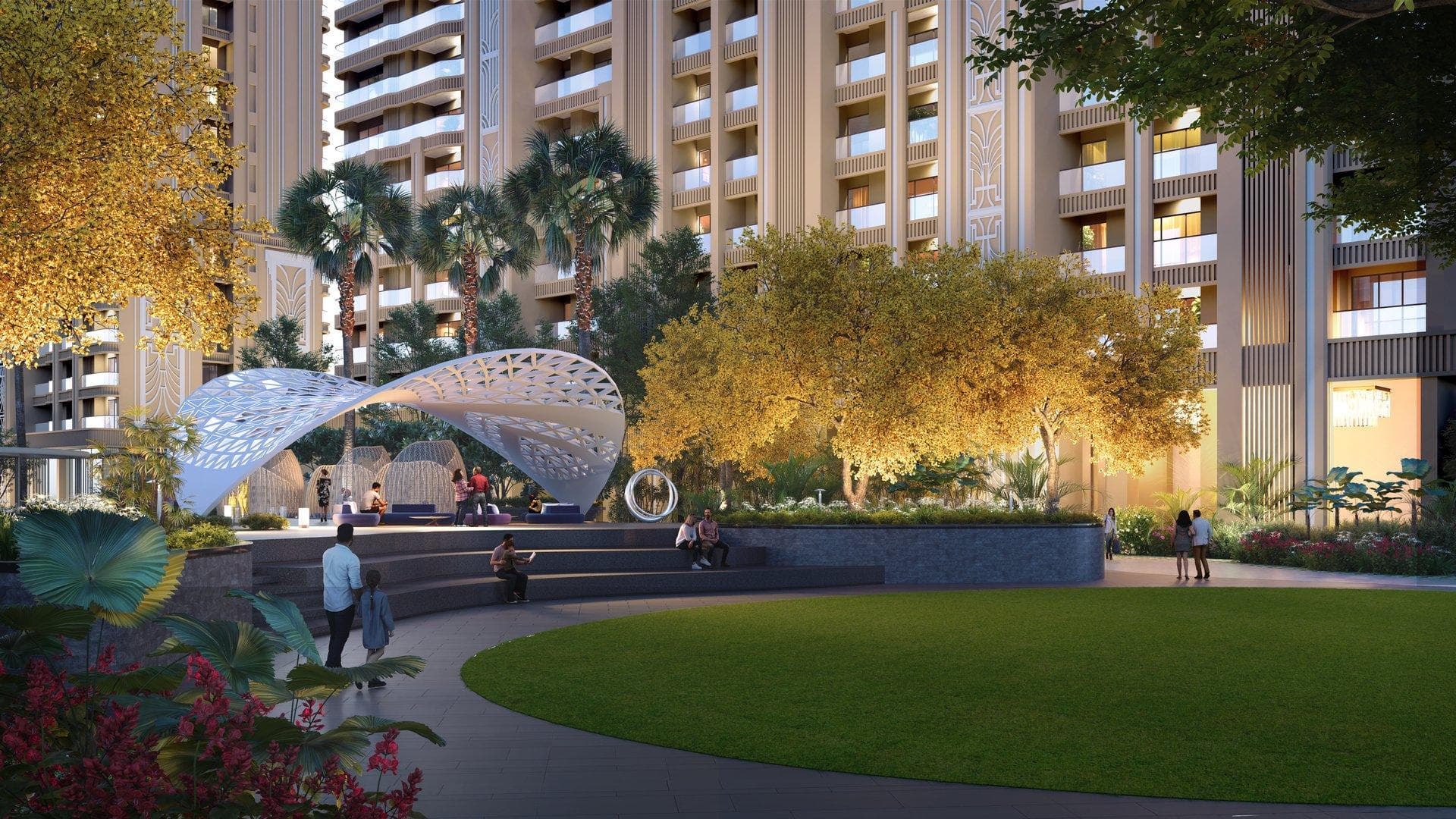
The plan leans into the corridor rather than hiding from it. Towers sit on 20 to 30-foot stilts, with central greens and a walking and cycling loop around the perimeter.
The clubhouse carries a 24/7 hospitality desk, dining venues, wellness and movement studios, racquet sports and guest suites. Residences come in 3 and 4 bedroom formats, with pricing shared on enquiry.
Possession is expected around 2031. That timeline sits alongside the metro build-out, which is worth factoring into your own planning.
See the masterplan and location for the connectivity map, and the residence layouts for the formats. Then drive the corridor yourself before you decide.
FAQ
When did the Dwarka Expressway open?
How far is the airport from the Dwarka Expressway corridor?
How much have prices risen along the corridor?
Is the Dwarka Expressway getting a metro connection?
Is the corridor good for end-use, or only investment?
What should I verify before booking here?
The Bottom Line
The Dwarka Expressway did what a good road does. It made a set of trips shorter and more predictable, and it did that every single day.
The airport run changed most. The school run, the grocery run and the weekend changed quietly, because through-traffic moved off local streets.
The value story is real but partly behind us. Corridor prices rose about 83% in ten years, and the average quoted rate has kept climbing since. (Source: ANAROCK via Free Press Journal, 2024 — ten-year growth)
What is still ahead depends on the metro spur, retail depth and delivery quality. Those reward specific projects, not the corridor as a label.
So judge the corridor on what is open, funded and verifiable. Then judge each project on its own merits within it.
If a managed, brand-operated address on this corridor fits your plans, look closely at Westin Residences. Drive it at rush hour first, then decide.
About the Publisher:This article is published by Whiteland Corporation, a premium real estate developer with a focus on lifestyle-led residential projects in Gurugram. The insights shared are based on evolving residential trends, buyer behaviour, and long-term market observations.
Recent Blogs
←Back to all blogs
What Makes a Residence Future-Ready?
Read More →
Why Well-Being Is Becoming a Differentiator in Real Estate
Read More →
The Value of Professionally Managed Living
Read More →